
Over the past decade, Fast & Light has evolved from a niche philosophy reserved for elite alpinists into one of the most influential structural forces in the outdoor industry. The pursuit of speed, efficiency, and minimalism is redefining how people move in the mountains—and how companies design, manufacture, and communicate performance products.
From 100-gram jackets to ultracompact packs, the demand for lighter, faster, and more adaptive equipment is accelerating innovation cycles across the sector. But the shift goes far beyond product design. Fast & Light reflects a deeper cultural and economic transformation in the modern outdoor consumer.
The Rise of Speed as an Outdoor Culture
Once associated with climbers like Mark Twight, Steve House, or Ueli Steck, Fast & Light has become a transversal mindset shaping trail running, fastpacking, skimo, gravel cycling, and lightweight alpinism. The core idea is simple: move faster, carry less, maintain performance and safety.
What began as a technical strategy for fast ascents has evolved into a full industrial paradigm. Consumers—more technical, informed, and environmentally aware—now push brands to innovate in materials, manufacturing, and storytelling. Fast & Light is no longer a trend. It is a structural shift in how the outdoor industry creates value.
During the early 2000s, elite athletes demonstrated that every gram mattered not only in speed but also in risk management—less weight meant less exposure. That philosophy has now captured a wider audience: younger, digital-native outdoor users who prioritize versatility over accumulation.
“Fast & Light is not an aesthetic; it’s a mindset. Every gram matters—not only in your pack, but in your decisions.” —Ueli Steck
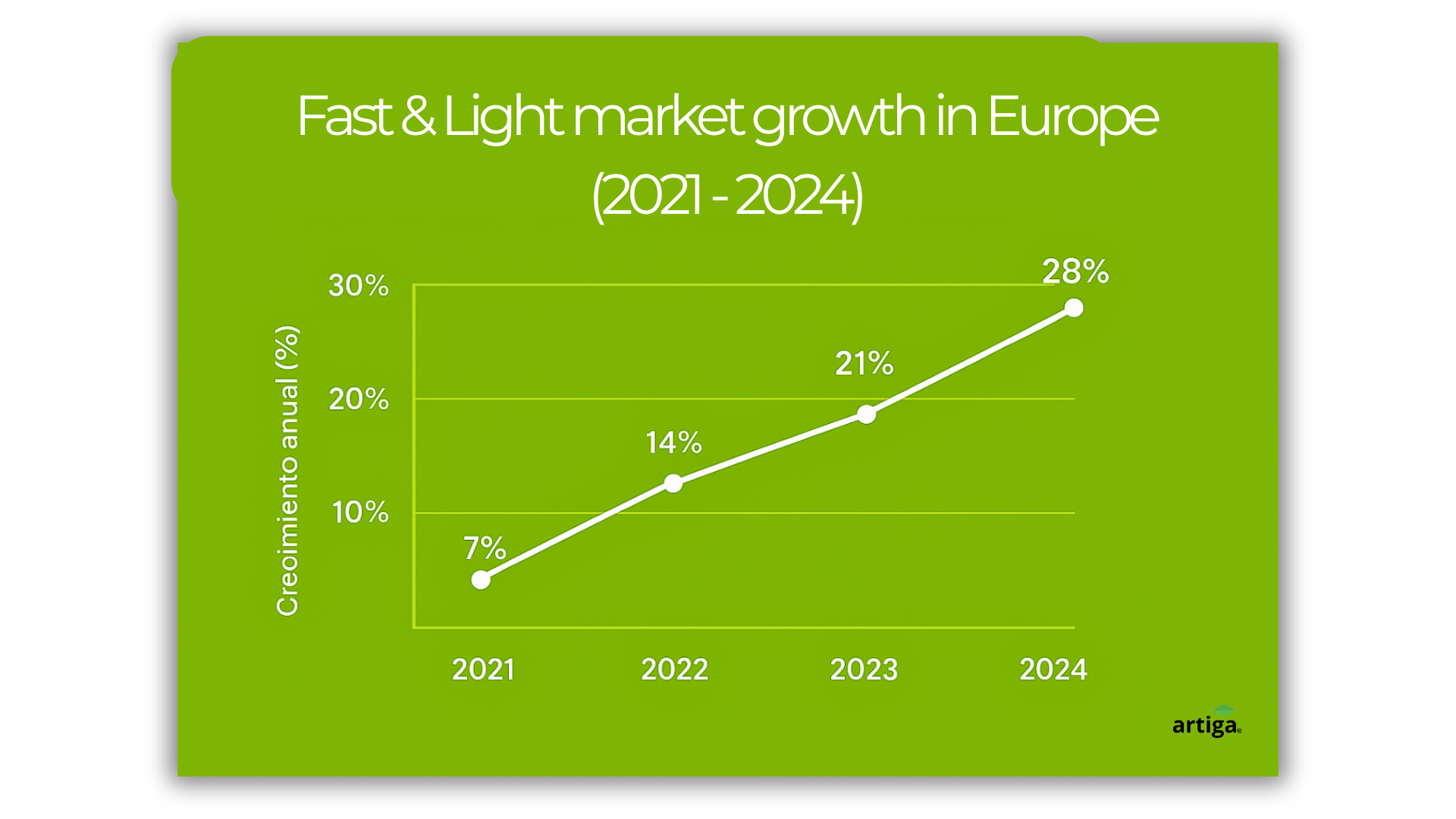
Data reflects the cultural shift. According to the European Outdoor Group (EOG), “lightweight” products grew 28% in sales between 2022 and 2024, leading technical categories such as jackets, packs, and mountain footwear.
Disciplines like trail running, ski mountaineering and fastpacking normalized the idea of carrying only the essentials—and the mainstream outdoor consumer quickly followed.
How Fast & Light Is Transforming Product Development
The Fast & Light mindset has forced R&D teams to rethink everything: materials, construction, durability, and performance.
- Hybrid and Technical Materials: Combinations of nylon ripstop, Pertex Quantum fabrics, or ultra-thin membranes offer durability without sacrificing weight.
- Minimalist Design: Elimination of unnecessary seams, reduced zippers, and integrated compression systems.
- Multifunctionality: A single garment or backpack should adapt to multiple conditions—from ascent to refuge to urban use.
This change has transformed the business models and innovation: lightness is no longer measured only in grams, but in total performance per unit of weight, a key indicator for brands such as Montbell, Dynafit, OS2O, or Arc’teryx. This trend is also accelerating development cycles, forcing teams to balance technology, durability, and environmental responsibility.
The “Fast & Light” audience is technically informed and highly digitalized. They’re not just buying a jacket or a pair of shoes; they’re buying efficiency, freedom, and purpose. This profile demands transparency around actual weight, material origin, and production traceability.
According to the Outdoor Consumer Trends Report 2025, 73% of buyers in Europe consider lightness a decisive factor, while 58% look for a balance between performance and sustainability. As a result, brands are investing more in consumer education and technical content (detailed spec sheets, explanatory videos, interactive comparisons).
According to the Outdoor Consumer Trends Report 2025:
- 73% of European buyers consider weight a decisive factor.
- 64% prioritize multifunctional products.
- 58% seek a balance between performance and sustainability.
This consumer gathers information through social media, detailed technical sheets, and specialized content, which forces brands to communicate with transparency and precision. Aspirational communication (epic adventures, generic slogans) is giving way to technical storytelling: explanatory videos, weight-comparison tools, and real mountain experience. Communication has also shifted: aspirational marketing is being replaced by functional storytelling, where real-world mountain use becomes the core of the message.
According to the European Outdoor Group (EOG), sales of products classified as “lightweight” grew 28% between 2022 and 2024, driven by technical apparel and mountain footwear. The segment of backpacks under 25L increased by 31%, and jackets under 300 g now represent 18% of the entire technical apparel market.
Innovation in Materials: Less Weight, More Performance
The Fast & Light principle has transformed how brands design products. The pursuit of lightness has driven the development of a new generation of technical fabrics and smart manufacturing processes.
- Ultralight ripstop fabrics (Pertex Quantum, Toray Airtastic): provide mechanical resistance with weights under 30 g/m².
- Next-generation membranes (ePE, FUTURELIGHT™, Sympatex): maintain waterproofing and breathability while reducing weight by up to 25%.
- Taped seams and ergonomic patterning: eliminate bulk and enhance freedom of movement.
- Bioengineered and recycled fibers: support PFAS-free compliance and sustainability targets.
The result: garments that are more efficient, more compact, and offer a better performance-to-weight ratio. Lightness becomes a technical KPI, not just a subjective feeling. However, when misunderstood, lightness can lead to less durable products. The industry is responding with eco-design strategies, prioritizing high-tenacity recycled materials, repair programs, and extended longevity testing.
Example: Patagonia has reduced the average weight of its mountaineering line by 22% without sacrificing durability; OS2O has developed its FAST&LIGHT™ system, prioritizing low-impact technical fabrics and maximum durability.
The challenge lies in finding the middle ground between lightness, performance, and circularity, a balance that will define the future of outdoor gear. But not everything that is lightweight is necessarily sustainable. Reducing weight can mean reduced durability, which conflicts with the principles of circular economy.
Leading brands are responding with three strategies:
- High-tenacity recycled materials (nylon 66, post-consumer polyester).
- Repair and second-life programs (Patagonia, Darn Tough, Vaude).
- Extended durability and longevity testing to prevent obsolescence.
In this sense, the future of Fast & Light will be inherently eco-designed, where lightness and sustainability are no longer opposites.
Beyond a Trend: A New Outdoor Paradigm
Fast & Light is more than an evolution of performance—it is a cultural shift in how humans interact with mountains, time, and technology. It reflects a society seeking to do more with less, and an industry learning to generate innovation without excess.
The brands that thrive in the next decade will be those capable of balancing:
- technical performance
- environmental responsibility
- authentic storytelling
The outdoor world of tomorrow will not be heavier.
It will be lighter, smarter, and more responsible.
Related articles and publications:
- Price Hikes at the Top of the World: Implications of the 36% Increase in the Everest Climbing Permit Fee – 2025
- Snapshot of the European Outdoor Market 2025: Growth, Leading Brands, and Key Segments – 2025
- Deportes de nieve sostenibles WOA (Spanish) – 2021
- Visión Global (Spanish) – 2021
- La industria del esquí en Suiza (Spanish) – 2022