
For much of its modern history, the outdoor industry knew how to imagine its customer. He was often technical, male, performance-driven, and fluent in the language of summits, mileage, storms, trailheads, and gear specifications. The category was built around competence: a better shell, a lighter pack, a warmer bag, a more stable boot.
That customer still exists. He matters. But he is no longer enough to explain the market.
The outdoor economy is now too large, too visible, and too culturally porous to be defined by one archetype. In the United States, outdoor recreation accounted for 2.4 percent of current-dollar GDP in 2024, representing $696.7 billion in value added, according to the Bureau of Economic Analysis. Participation has also reached historic levels: the Outdoor Industry Association reported that 175.8 million Americans, or 57.3 percent of the population aged six and older, participated in outdoor recreation in 2023.
But the most important signal is not simply that more people are going outside. It is that they are going outside differently.
The participant base is expanding, while commitment patterns are changing. OIA found that the average number of outings per participant fell from 70.5 in 2022 to 62.5 in 2023, even as overall participation grew. That is the paradox now facing outdoor brands: the market is wider, but in many cases lighter; more accessible, but less predictable; more culturally influential, but harder to own.
The next phase of outdoor growth will not be won by brands that merely sell better equipment. It will be won by brands that understand why people now enter the category, what keeps them there, and how the meaning of “outdoor” itself is being rewritten.
These are five consumer shifts changing the industry.
1. The outdoor consumer is no longer a generation. It is a portfolio of life stages.
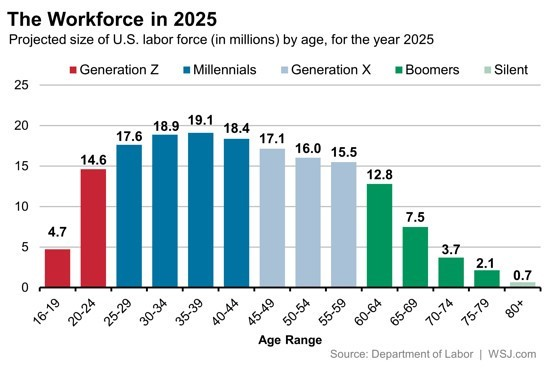
For years, the industry spoke about millennials as if they were the future. That framing is now dated. Millennials are no longer the coming customer; they are a central part of the adult economy. In the U.S. labor force, millennials represented the largest generational share in the second quarter of 2024, at 36 percent, followed by Gen X at 31 percent, Gen Z at 18 percent, and baby boomers at 15 percent.
The implication is subtle but important. A millennial consumer may now be a first-time parent buying a family tent, a founder building a remote-work lifestyle around trail access, a premium buyer trading up to durable apparel, or a former core athlete with less time but greater spending power. The old “young experience-seeker” label is too narrow.
At the same time, Gen Z is entering the market with different expectations around identity, price, community, mental health, and digital discovery. Older consumers are also becoming more important. OIA’s 2025 participation summary highlights growth among both seniors, up 7.4 percent, and youth, up 5.6 percent, alongside gains in gateway activities such as hiking, camping, and fishing.
This makes the outdoor customer less like a single persona and more like a portfolio.
The smartest brands will stop asking, “How do we speak to millennials?” and start asking a more useful question: what job is the outdoors doing in this person’s life?
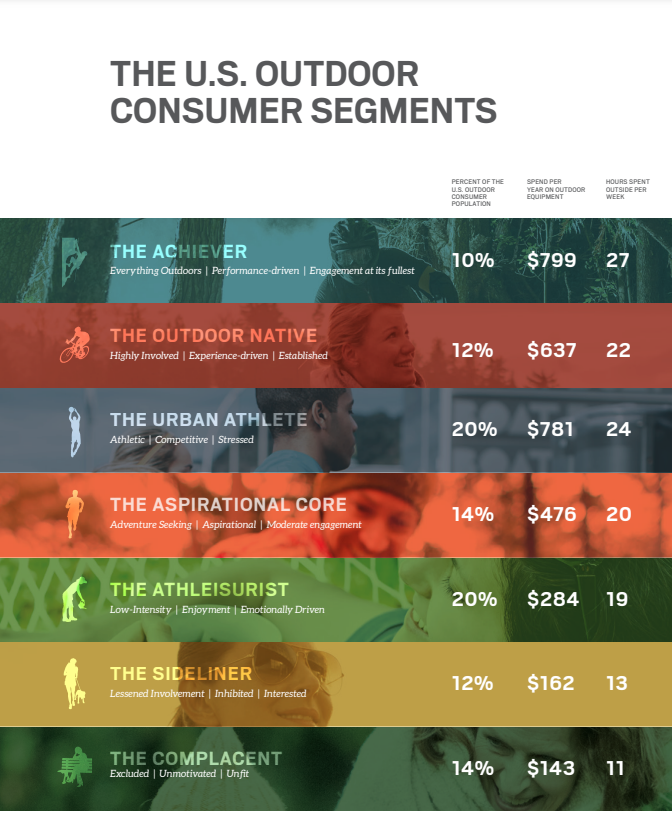
For some consumers, the outdoors is fitness. For others, it is escape. For some, it is family time, status, climate identity, recovery, travel, community, or simply a way to feel less trapped by urban life. These motivations can overlap, but they do not require the same products, the same tone, or the same retail experience.
The business consequence is clear. Brands built around elite aspiration must learn to serve entry, return, and re-entry. The consumer who buys a trail shoe for a weekend hike may become a trail runner. The parent buying a child’s first fleece may become a lifetime household customer. The senior joining a walking group may care less about alpine mythology and more about comfort, trust, fit, and safety.
Growth will come not only from selling to the already converted, but from designing pathways for the almost-converted.
2. “Outdoor” has become a design language, not just a use case.
The boundaries of the outdoor category are dissolving.
A waterproof jacket is no longer only a mountain product. A trail shoe is no longer only a trail product. A technical fleece is no longer only a midlayer. Outdoor design has entered the everyday wardrobe, and everyday fashion has absorbed outdoor codes: ripstop fabrics, utility pockets, trail silhouettes, weather protection, climbing references, expedition colors, and the visual grammar of durability.
McKinsey and The Business of Fashion identified this shift as “outdoors reinvented,” noting that technical outdoor clothing and gorpcore were in demand as consumers embraced healthier lifestyles, while outdoor brands moved into lifestyle collections and lifestyle brands embedded technical elements into their products.
This is not just a fashion trend. It is a category disruption.
Outdoor brands once competed mainly with other outdoor brands. Now they compete with running brands, yoga brands, luxury fashion houses, streetwear labels, travel brands, workwear companies, and digitally native apparel players that understand lifestyle positioning better than many traditional gear companies.
The consumer no longer asks only, “Will this work in the mountains?” They also ask: “Can I wear it to work? Does it pack well? Does it look right in the city? Does it say something about how I live?”
That shift creates opportunity, but also risk.
For heritage outdoor brands, the opportunity is to reach consumers far beyond the trailhead. The risk is dilution: if every product becomes lifestyle, the brand may lose the credibility that made it valuable in the first place. For fashion and athleisure brands, the opportunity is to borrow outdoor credibility. The risk is superficiality: technical language without technical trust.
The winning position will belong to brands that can hold two truths at once: real performance still matters, but performance alone is no longer the whole story.
A rain shell must still keep water out. A hiking shoe must still protect the foot. A pack must still carry weight intelligently. But the product also lives in photographs, commutes, airports, coffee shops, co-working spaces, school runs, and urban parks. The mountain has become both a place and a symbol.
For outdoor companies, this means product teams, brand teams, and retail teams can no longer work in isolation. Design, merchandising, storytelling, athlete programs, creator partnerships, and store environments must all answer the same question: where does this product belong in the consumer’s actual life?
Not the life imagined in a summit campaign. The real one.
3. Performance is the ticket to entry. Meaning earns the premium.
Technical performance used to be a powerful differentiator. Waterproof. Breathable. Ultralight. Durable. Packable. Abrasion-resistant. These words still matter, especially in categories where failure has real consequences. But in many parts of the market, they have become expected rather than exceptional.
A consumer buying premium outdoor apparel assumes the basics will work. The more difficult question is why they should care about one brand over another.
That is where meaning enters.
Today’s outdoor consumer often buys into a system of values as much as a product system: repairability, resale, local manufacturing, lower-impact materials, fair labor, climate commitments, access to nature, inclusive sizing, community programs, or credible advocacy. These factors do not replace performance. They sit on top of it.
Patagonia’s Worn Wear remains one of the clearest examples because it turns a brand value into an operating model. The program allows customers to trade in and buy used Patagonia gear, and the brand explicitly frames repair, reuse, and reduced consumption as central to the product’s life cycle. Its repair service also invites customers to mail in damaged gear or bring it to a store, with recycling offered when repair is no longer possible.
The broader market is moving in the same direction. ThredUp projects the global secondhand apparel market will reach $393 billion by 2030, growing faster than the overall apparel market. For outdoor, this is especially relevant because durability, repair, and resale are not peripheral ideas. They are native to the category’s best products.
But values are becoming more complex to communicate.
Consumers may care about sustainability, but they also face inflation, housing pressure, travel costs, and price sensitivity. Industry executives are making trade-offs as well. McKinsey’s 2025 sporting goods report noted that sustainability remains a priority, but its importance has declined among executives compared with the previous year, as business pressures force harder decisions.
That tension should make brands more careful, not quieter.
The premium opportunity is not to claim moral superiority. It is to build trust through specificity: what materials changed, what emissions were reduced, what can be repaired, what is guaranteed, what is still imperfect, and what the company is doing next.
Outdoor consumers are increasingly fluent in brand language. They can detect vague purpose. They can also reward seriousness. A cause without operations feels like marketing. A cause embedded in product design, supply chain, repair infrastructure, and customer behavior becomes strategy.
In the next era of outdoor branding, meaning will not be a campaign layer. It will be part of the product architecture.
4. The city is now part of the outdoor industry.
The old outdoor story began with departure: leaving the city, escaping the pavement, reaching the trail, the crag, the river, the snowline. That story still has power. But it no longer captures how millions of consumers actually encounter the outdoors.
For many new participants, outdoor life begins inside the city: a park loop before work, a climbing gym after class, a weekend greenway ride, a local running group, a public beach, an urban trail, a stair workout, a micro-adventure at the edge of town.
This does not make their participation less real. It makes it commercially important.
OIA’s recent findings point to growth in gateway activities such as hiking, camping, fishing, biking, and running, each gaining more than two million participants in the 2025 summary. These are not necessarily consumers entering through expedition culture. Many are entering through accessible, repeatable, low-friction experiences.
That changes the role of brand storytelling.
Traditional outdoor marketing often glorified distance: remote landscapes, extreme weather, elite athletes, and technical mastery. Urban and suburban consumers may still admire those images, but admiration is not the same as conversion. To bring new users into the category, brands must make the first step feel legitimate.
A person walking in a local park should not feel like an outsider to the outdoor industry. A commuter wearing a technical shell should not be dismissed as a “lifestyle” customer. A beginner joining a weekend hike should not have to decode a culture before buying a pair of boots.
The urbanization of outdoor also changes product needs. Consumers want versatility, but not in a vague way. They want pieces that move between transit, travel, weather, work, fitness, and recreation. They want footwear that can handle a wet sidewalk and a gravel path. They want apparel that performs without looking overbuilt. They want products that lower the threshold of participation.
This is where some traditional outdoor brands struggle. They know how to speak to aspiration, but not always to access. They know how to dramatize the summit, but not the habit.
The next growth market may not be the person planning an expedition. It may be the person trying to make outdoor movement a normal part of a crowded week.
For brands, that requires a new kind of imagination: less conquest, more continuity; less escape, more integration; less “go farther,” more “start here.”
5. Inclusion is no longer a side issue. It is market infrastructure.
For decades, the outdoor industry presented a narrow image of who belonged outside. That image shaped advertising, product design, retail environments, athlete rosters, media coverage, sizing, pricing, and the unspoken social codes of outdoor culture.
The market is now forcing a correction.
OIA reported that in 2023, for the first time, more than half of American women participated in outdoor recreation. The female participation rate reached 51.9 percent, up from 50 percent in 2022. Members of the LGBTQ+ community also remained the most active adult cohort, with a participation rate of 60 percent.
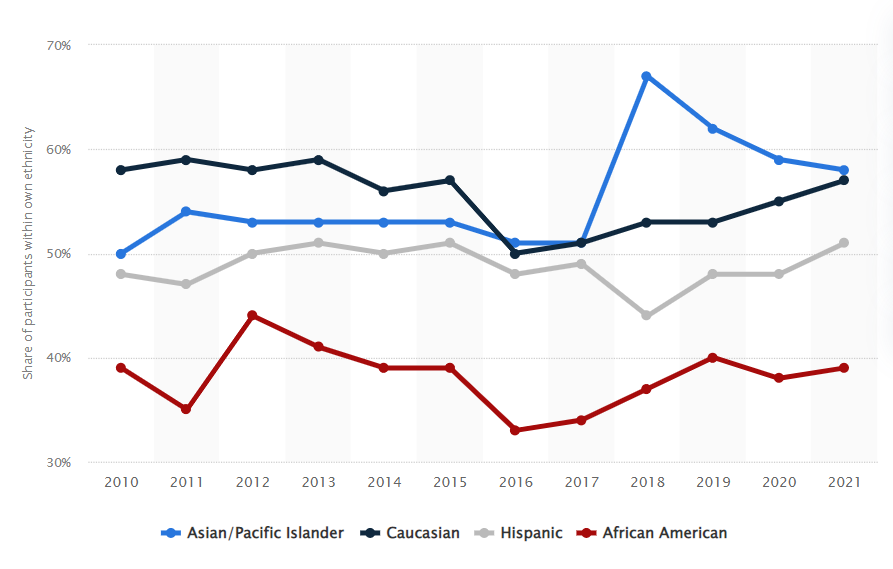
At the same time, participation is becoming more racially and ethnically diverse, though slowly. OIA reported that in 2023 the participant base was 69.7 percent White, 10.3 percent Black, 13.4 percent Hispanic, 5.3 percent Asian or Pacific Islander, and 1.4 percent people of other ethnic or racial origins. The direction of travel is clear, but the gap between participation and full cultural belonging remains significant.
This is not only a moral question. It is a business question.
An industry that fails to broaden belonging limits its own addressable market. An industry that treats inclusion as a campaign rather than an operating principle misses the deeper opportunity.
True inclusion affects the whole system: who appears in imagery, whose bodies are considered in fit, which price points are available, what languages are used, which communities are supported, where stores are located, how beginners are welcomed, how safety is communicated, and who is invited into product testing.
It also requires a more nuanced understanding of aspiration. Not every consumer wants to see a professional athlete on a remote wall. Some want to see a family that looks like theirs at a campground. Some want to see larger bodies moving comfortably. Some want to see women represented beyond tokenism. Some want to see outdoor culture without the pressure to perform expertise.
The industry should be careful here. Inclusion cannot become another aesthetic trend. It must be visible in hiring, partnerships, product, community investment, and long-term accountability.
The brands that lead will not be those that simply say “everyone belongs outside.” They will be the brands that remove the practical, cultural, economic, and psychological barriers that have told many people the opposite.
The new outdoor consumer is not less serious. They are serious in new ways.
It would be easy to misread these shifts as a softening of the outdoor industry: less technical, less committed, less authentic. That would be a mistake.
The market is not becoming less serious. It is becoming serious about more things.
Consumers still care whether gear works. But they also care whether it fits their life. They care whether the brand has a point of view. They care whether products last. They care whether the outdoors feels accessible. They care whether a company understands the difference between selling adventure and supporting participation.
For outdoor brands, the challenge is not to abandon heritage. Heritage is still one of the industry’s strongest assets. The challenge is to make heritage usable for people who did not inherit the old codes of outdoor culture.
The next five years will reward brands that can operate across several terrains at once: performance and lifestyle, technical credibility and emotional relevance, sustainability and affordability, elite aspiration and beginner access, wild landscapes and urban routines.
The outdoor industry used to ask consumers to come to the mountain.
Increasingly, the mountain is coming to them.
Related articles and publications:
- Fast & Light: How Rapid, Minimalist Outdoor Activities Are Reshaping the Industry – 2026
- Snapshot of the European Outdoor Market 2025: Growth, Leading Brands, and Key Segments – 2025
- Outdoor Brands Index
- Thule Group (Spanish)– 2022
- Hipcamp (Spanish) – 2022
- Price Hikes at the Top of the World: 36% Increase in the Everest Climbing Permit Fee – 2025